
Lukashenko instructed to establish iron discipline in the agricultural sector of the Vitebsk region by January 1
President of Belarus Alexander Lukashenko has ordered to establish iron discipline in the agro-industrial complex of the Vitebsk region by January 1. He stated this during a meeting in Vitebsk, as reported by a BELTA correspondent.
-
Lukashenko on the Vitebsk Region: a clear plan for the real revival of the region is needed
"I did not come to the Vitebsk Region to intimidate you. We have been working together for 30 years, and you know my approach. If you have not understood me or deceived me, everything will be tightened to the limit," the Belarusian leader said. Alexander Lukashenko suggested a scheme for action at various levels: "After today's meeting, the chairmen of district executive committees should invite chief specialists and managers and convey the strictness of this conversation to them. They have been given a deadline of November 7 – there is no more time – to establish iron discipline in the farms. They, as managers and specialists, should gather there mechanizers, milkmaids, and others. And by January 1, everything you have must be thoroughly cleaned and put in order."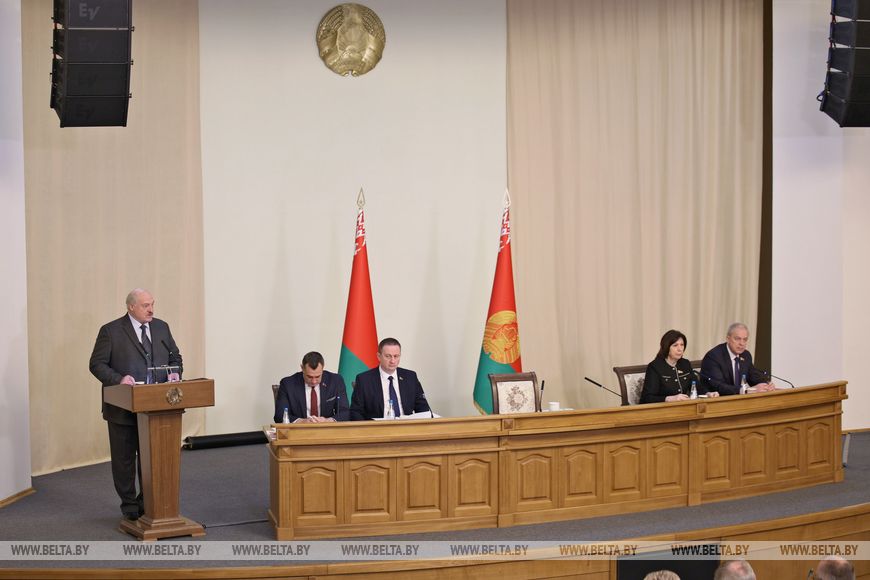
If there is a shortage of personnel in certain farms, the President has instructed to attract the patronage of other enterprises. "People came, did the job, restored [the situation]," he said. "That's it, guys. The nonsense is over," Alexander Lukashenko warned. At the same time, he noted that everyone will be treated humanely, provided they work honestly and responsibly: "I know your labor. If you are negligent, covering for each other, hiding shortcomings, and reporting to me not what is true (I then spend huge sums to uncover the real information), there will be no forgiveness. Understand me as you wish." "For some, this region is native. For me, the entire republic is my native land. We must restore order and pass the reins of leadership to the youth. But we must restore it. This is a disgrace (the current situation in the region. - BELTA note), - emphasized the Belarusian leader. "Do you want a war? We don't need a war. We need an economy." "Guys, either you start working, or we will build different relations with you. I am speaking frankly. I have the right to do so. Because you have deceived me more than once under three governors. I have stated the facts. Therefore, I have the right to hold you accountable. Of course, I could have smiled, said that tomorrow we would fix something, scolded you in private, given you a chance, and left. That is not my style. I have told you directly, to your face. I have the right to do so – constitutional and as a person who has gone through the path that you are going through now," Alexander Lukashenko noted. "That's it, guys, the nonsense is over. Starting from January 1 of this year," the Head of State emphasized once again. "Go and restore order." This requirement of the President – for mandatory restoration of order and active measures – equally applies to the situation in the industrial sector. "We have enterprises in industry, ("which. - Note BELTA) failed today. They are sitting and waiting for something. What are you waiting for? Take your legs in hand and run, starting from South Africa and ending at the North Pole. And when you arrive, you will say how many tractors and combines you sold while running to the North Pole," - said the head of state. Expanding the geography of exports should be done by following the example of Belarus' actions in Zimbabwe, where domestic machinery and technologies are currently being acquired willingly, because they have been convinced of Belarus' reliability as a trade and economic partner and its interest in developing cooperation. Similarly, relations with Libya are now being intensified, and as a result, the volume of mutual trade is increasing. "When they start doing things seriously, when they go, move around - look, there a thousand, two thousand (products sold. - Note BELTA). And then combines, tractors went," - noted Alexander Lukashenko, emphasizing that the quality of domestic products must be high at the same time.